Showing posts with label Manchester. Show all posts

Saturday, 16 April 2016

A Desirable Address: Manchester


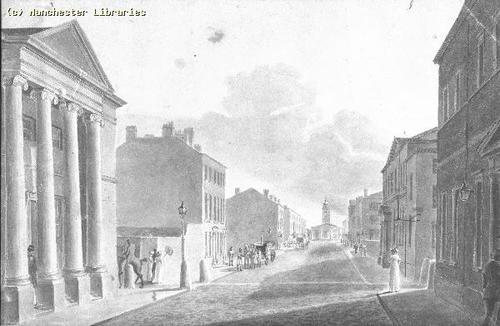
 Mosley Street was laid out in the 1780’s and named after the lords of the manor. The area had been entirely residential and very fashionable.  Here lived Manchester’s greatest merchants and businessmen. Hugh Birley was a cotton spinner and manufacturer of rubber goods. S. L. Behrens was the founder of the firm of shipping merchants and Nathan Meyer Rothschild was of the banking family.
image
                                             Mosley Street 1825

In 1827 Henry Charles Lacy converted a house at the corner of Mosley Street and Market Street into an hotel and allowed rooms in the building to be used for warehousing.  A rash of house conversions and warehouse building followed over the next decade as property values soared. One house was sold in 1832 for eight thousand guineas, twice its’ vaue of only five years earlier. By the end of the thirties, Mosley Street consisted almost entirely of warehouses, the former resident having moved to the new suburbs such as Victoria Park and Didsbury.

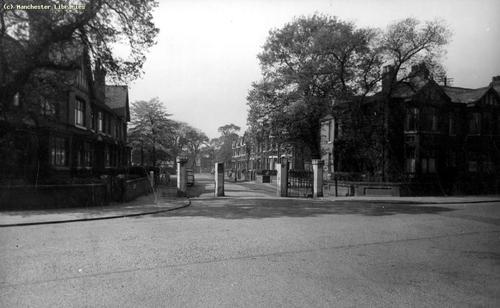
Victoria Park was opened in 1837.  An area of 140 acres had been obtained by a company of gentlemen in order to build villas which would be let for between £100 and £250 per annum. The notable architect, Richard Lane was engaged to design the park, laying out roadways, boundaries and landscaping and designing the gate lodges. The park had its’ own tollgates, walls and police.
image
                                  Plymouth Grove Toll Gates

By December of the following year only nine houses had been completed and the company was bankrupt. A new group, The Victoria Park Trust was founded. Within the next five years a further sixty five houses had been built.  These were often large mansions with extensive gardens and required a sizeable staff to maintain them.  By the end of the nineteenth century, these villas were already being converted into hotels, colleges and nursing homes. Their weathy residents had been tempted to move further from the city to the newly fashionable area such as Bowden and Alderley Edge.

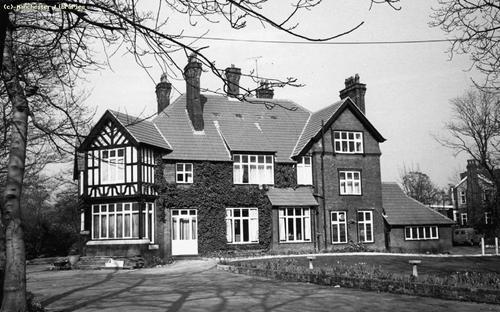
The building of Victoria Park was by a number of architects in addition to Lane,  Edward Salomons built “The Gables” and this was to become his home.
image
                                    The Gables, Hope Road
image
                           First Church of Christ, Scientist
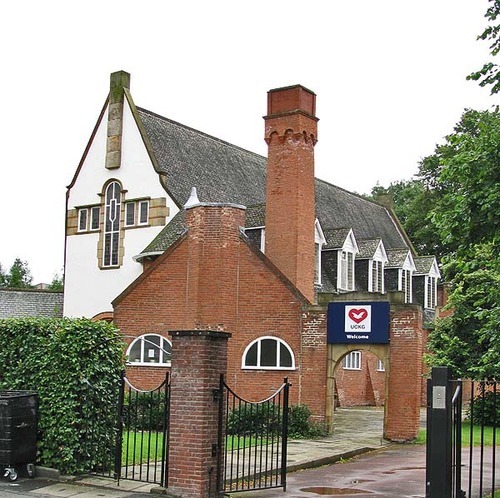
In Daisy Bank Road is the Grade 1 listed “First Church of Christ, Scientist” built by Edgar Wood in 1903 and on Lower Park Road the Xaverian College by Alfred Waterhouse, now a Roman Catholic school for 2000 pupils.

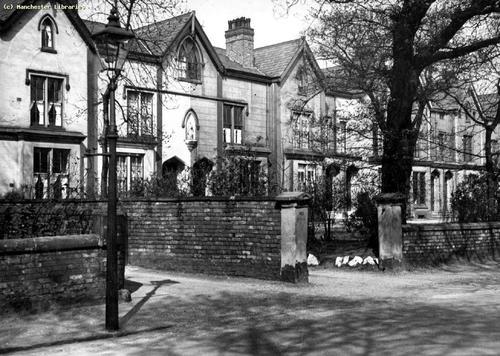
The park was home to a number of notable residents. 102 Daisy Bank Road was home to Charles Halle and was later occupied by Ford Madox Brown at the time when he was painting the murals in Manchester Town Hall.
image
            Daisy Bank Road. 102 is the first door on the right.
Richard Cobden was a calico printer and political activist. In Newton Street lived Emmeline Pankhurst, leader of the suffragette movement and in nearby Plymouth Grove was the home of author Elixabeth Gaskell. Marie Nordlinger and Martin Solibakke were both writers; Elias Bancroft, a painter and  George Hadfield a lawyer and radical polititian who played a leading role in establishing the Anti Corn Law League. People from a number of nationalities lived in Victoria Park including a large chinese merchant community.
image
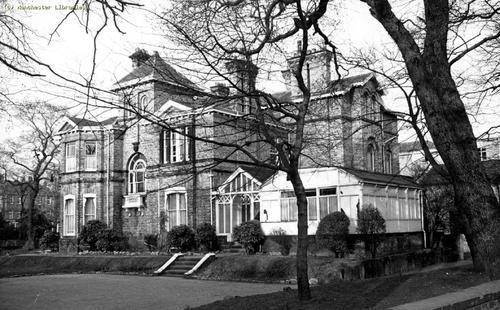
                                       Lower Park Road

Today many of the buildings are used as university residences whilst others have been converted into flats. Victoria Park is a conservation area and twenty of its’ buildings are listed.

Saturday, 12 October 2013

In Good Company - Southern Cemetery, Chorlton cum Hardy

Sir Matt Busby and Lawrence Stephen Lowry need no introduction, neither perhaps does Sir John Alcock.  These are among the famous names to be discovered on the graves of Southern Cemetery in Manchester.


In 1872 40 hectares of land were purchased by Manchester Corporation for £38340.  The City Surveyor J. G. Lynde was responsible for designing the layout and manchester architect H. J. Paull designed the chapels and other buildings. Roman Catholics, Nonconformists Jewish and Anglican denominations each had their own chapels and designated burial areas.  In 1926 a further 36 hectares was purchased making this the largest cemetery in Britain and second largest in Europe.


There are now separate areas designated for Muslim burials, the Commonwealth War Graves Commission and for the Polish community. The latter includes a large memorial to Katyn massacre in 1940 when 22000 prisoners were executed by the Soviet authorities.


Sir Matt Busby was of course the famous and revered manager of Manchester United who died in 1994. He shares a grave with his wife Jean.  Nearby is his former friend and racecourse owner, Willie Satinoff who died in the Munich air disaster. Billy Meredith had played for both City and United and earned 48 caps for Wales. He died in Manchester in 1958.


L. S. Lowry died in 1976 and shares his parent's grave.  Lowry never married and left his estate to Carol Ann Lowry, a fan who had written to him because she shared his name.


Perhaps only the older generation will remember Wilfred Pickles who was buried in Chorlton in 1978.  Pickles born in 1904 spent his life in show business appearing in films, on T.V. and as a wartime newsreader. The BBC received numerous complaints about his Yorkshire accent but supported him stating that should therebe a German invasion and a take over of Broadcasting House, it would be easy for the voices of most announcers to be mimicked. No German however would be able to imitate Wilfred's voice. Once the threat of invasion receded, he was no longer needed.  He became in 1946, the presenter of the radion programme "Have a Go" together with his wife Mabel.  It was for this show which ran for 21 years that he is best known.


Sir John Alcock, born in Stretford was an R.A.F captain.  He had learned to fly in 1912 and joined the Sunbeam Car Company as a racing pilot. When war broke out, he first enlisted with the Royal Naval Air Service. Whilst stationed in the Greek island of Lemnos, he built his own aircraft the "Alcock Scout" from remnants of several different aircraft. He earned a Distinguished Service Cross in 1917 for attacking three enemy aircraft. When piloting a bomber on a raid to Constantinople, he was forced to ditch in the sea. Unable to attract a British Destroyer he swam ashore and was taken captive by the Turkish forces and not released until the Armistice.  Attracted by a £10000 prize offered by the Daily Mail, he joined Arthur Whitten Brown in an attempt to cross the Atlantic non stop. Taking off from St.John's Newfoundland in  a Vickers Vimy bomber, they struggled against bad weather as well as instrument failure and icing.  16 hours later on 15th June 1919, they landed at Clifden in County Galway, after the first  non stop flight across the Atlantic. A few days later they were received at Windsor Castle and knighted by King George V.  In December 1919, Alcock was piloting a new aircraft to the Paris Air Show when he crashed in fog near Rouen suffering a fractured scull from which he died.

The grave of a survivor of the Charge of the Heavy Brigade is to be found as well as two recipients of the Victoria Cross, Major Henry Kelly (WWI) and Colour Sergeant John Prettyjohns (Crimea).

The firm of McDougall Brothers of Manchester became the first of Britain's large flour companies opearting mills throughout the country. Established in 1864 they had pioneered self raising flour as early as 1869.  A member of the family Sir. R. McDougall is buried at Chorlton. 


The grandest memorial is to John Rylands whose widow Enriqueta's ashes are in the vault below.  Rylands was an industrialist and philanthropist and Manchester's first multi millionaire. His was the largest cotton manufacturing company in Britain. He died in 1888 at his home Longford Hall leaving hius estate of over £2.5 million to his wife. It was she who built the John Rylands Library in his memory.


Jerome Caminada was born in Deansgate in 1844 to an Italian father and Irish mother.  Deansgate at the time was a street of pubs and brothels and a hotbed of crime. Having first worked as an engineer, Jerome joined the police force in 1868. Within four years he had been promoted to sergeant and transferred to the detective department.  He was to become the first C.I.D. superintendent in Manchester.  His methods were unconventional. He often wore disguises, used handwriting recognition and keen observation. He often met with his large network of informers in St Mary's Church.  His life was threatened on a number of occasions and Caminada often carried a pistol which he used several times. His reputation for success became known nationally for he imprisoned over 1200 criminals and closed down 400 illegal drinking houses.

Anthony H. Wilson was buried at Southern Cemetery as recently as 2007.  He is known as a broadcaster, a journalist and imressario.  Wilson founded Factory records and opened the Hacienda nightclub, at the time probably the best known club in the World.  He was a manager of a number of successful bands including Happy Mondays, New Order and Joy Division. He will be remembered as one of Manchester's greatest ambassadors.

There are regular guided tours of Southern Cemetery details of which are on the internet. It would be difficult to explore this vast site alone without missing much of its' fascinating history. 


Wednesday, 12 December 2012

The Libraries of Manchester

Few people realise the importance of Manchester's historic libraries. The collections exceed a total of two milllion volumes and a significant number of ancient works are of worldwide importance.


Chetham's Library


The oldest library is Chetham's which has been a free public library since 1653, the oldest in the U.K. The collection contains over 100,000 books, the majority published before the mid 19th century

The Chethams complex includes one of Manchester's oldest buildings dating from 1422. Built as a manor house, this became a priest's hostel, being alongside the Collegiate Church, now Manchester Cathedral. During the Civil War, it served first as a gunpowder factory and later a prison.

Sir Humphrey Chetham 1580 - 1653 was a successful cotton merchant. He had been educated at Manchester Free Grammar School which was then sited between the later Chetham's Hospital and the Church. He was offered a knighthood in 1631 due to his great wealth and was fined for refusing the honour. He was not able to refuse the post of High Sheriff of Lancashire in 1635 nor of General Treasurer in 1643. He feared that on his death, his wealth might be taken by the Crown and for this reason he bequested money for the establishment of Chetham's Hospital which was to support 40 poor boys and Chetham's Library together with funds for the purchase of books. 24 feoffees or trustees were appointed to manage and stock the library and their aim was to rival the university libraries of Oxford and Cambridge. The building was extended during the Victorian era as was the Grammar School, the latter moving to it's present site in Fallowfield in the 30's.  The books were originally chained although that practice ended in the mid 18th century.

Karl Marx and Friedrich Engels were frequent visitors to Chetham's and a reference book and bench seat mark the spot where they used to meet.

Chetham's Library is open Monday to Friday and visitors are welcome. An appontment must be made in order to read any of the collection.

Further information : http://www.chethams.org.uk/index.html


-------------------------------------------------------------------------------------------------------------------

John Ryland's Library


The John Ryland's Library on Deansgate forms part of the University of Manchester Library. The principal buildings are on Burlington Street within the University Campus although parts of the collection are housed at a number of sites.
More than quarter of a million books are housed and over a million documents and archive items.

John Rylands was a textile manufacturer. He was Manchester's first mutil millionaire and employed 15000 at his 17 mills. His home was Longford Hall in Stretford. Rylands was a philanthropist supporting numerous charities including chapels, orphanages and retirement homes for ministers and gentlewomen. In Stretford he provided a library, baths, town hall and coffee house. He was generous in supporting the poor of Rome and in 1880, the King honoured him with the Order of the Crown of Italy. Rylands died in 1888 leaving the bulk of his estate to his wife Enriqueta, more than £2.5 million. He is buried in Southern Cemetery.

Enriqueta Augustina Rylands obtained a site on Deansgate in 1889 and commissioned Basil Champneys, a notable architect to design a library in memory of her husband. The Victorian Gothic building has an ecclesiastical style which refelcts it's original intention to house principally theological works. Construction was completed in 1899 and the library opened in October with a collection of some 40,000 books. Much of the collection is rare including more than 3000 books printed prior to 1501. On her death in 1908, Mrs Ryland bequeathed £200,000 to expand the collection, more than 180,000 books being acquired. The merger with the University Library was in 1972.

The Library is open daily and also houses a cafe. For more information :

http://www.library.manchester.ac.uk/deansgate/visitus/

---------------------------------------------------------------------------------------------------------------------------------------------------

The Portico Library


Situated on Mosley Street The Portico Library is a private subsciption library. The building in the Greek Revival style was designed by Thomas Harrison and opened in 1806. The library was initiated by a group of businessmen and financed by subscription. The collection of 25,000 books is mainly of 19th century literature. The Library and Gallery are on the upper foors accessed through a doorway on Charlotte Street. The ground floor once housed the Bank of Athens and is currently occupied by the Bank public house.
The Gallery houses regular exhibitions, often of artistic works.

The Portico Prize for Literature is presented biennially for works of fiction and non-fiction.

The Library is open Monday to Saturday although normally only the Gallery area is open to the public. Light
refreshments are available

The first secretary was Peter Mark Roget who started work on his Thesaurus whilst in Manchester. Famous members have included John Dalton, Richard Cobden, Sir Robert Peel, Thomas De Quincy, Elizabeth Gaskell and more recently Eric Cantona.

---------------------------------------------------------------------------------------------------------------------------------------------------

Manchester Central Library


Manchester's municipal library in St Peter's Square is currently closed for a major renovation which will not be completed until 2014. The bulk of the collection is in temporary storage in a Winsford Salt Mine. Interim library facilities are provided at Eliot House, Deansgate.

Manchester's first public library opened in 1852 at Campfield near Liverpool Road Station. When this building became unsafe, the Library moved to the old Town Hall which stood on King Street. The book collection had grown too large  by 1912 and a further move was made to the redundant Infirmary buildings in Piccadilly Gardens. This was intended to be a temporary solution but progress on a replacement building was delayed by the First World War. A competition to design a Town Hall Extension and the new Library was held in 1926 and won by the architect Emanuel Vincent Harris.

 The foundation stone was laid by Prime Minister, Ramsay MacDonald in May 1930 and the large domed, rotunda in a neoclassical style, was completed in 1934 and opened by King George V on 17th July. 

The basement housed the Library Theatre which is now to be relocated to new premises which it will share with Cornerhouse. Below the Great Hall are four floors of shelving able to store 1 million books in environmentally controlled conditions.

The collection includes many editions of historic importance including books printed before 1500 and the total stock is in the region of 2 million volumes.. 


Tuesday, 16 October 2012

Engels in Manchester

Friedrich Engels lived in Manchester from December 1842 until 1844. He had been sent by his parents to work at the Ermen and Engels, Victoria Mill in Weaste. His father hoped that the experience would make him re-consider his radical views.

Whilst in Manchester, Engels visited some of the most deprived districts and wrote extensively of the working and living conditions that he observed.

"Such is the old town of Manchester...instead of being exaggerated, it is far from black enough to convey the impression of the filth, ruin and uninhabitableness, the defiance of all considerations of cleanliness, ventilation and health which characterize the construction of this single district, containing at twenty to thirty thousand inhabitants. And such a district exists in the heart of the second city of England, the first manufacturing city of the world. If anyone wished to see in how little space a human being can move, how little air - and such air! - he can breathe, how little of civilization he may share and yet live, it is only necessary to travel hither" (Friedrich Engels 1845, The Condition of the Working Class in England, p86)


Engels again visited Manchester in the summer of 1845 in the company of Karl Marx and was to return to live in the city between 1850 and 1870. He again worked for his father's firm earning £100 per annum and 10% of the profits. On his father's death, he inherited the sum of £10000 and 20% of the firm's profits.  Ironic that he benefited so much from the capitalism that he so opposed.

Marx visited Engels in Manchester on a number of occasions and received considerable financial support from his friend.